Healthcare, Service & Social Welfare
Bahuji Daftari Smarak Trust was established in the year 1991,in Nagpur, Maharashtra State, with the sole purpose of propagating the teachings of Late Dr. K.L. alias Bhauji Daftari. It runs various clinics here, purely on charitable basis. They are located mainly in the slum areas of the city. Many poor people are benefited by this venture. Not only are the regular follow up of the patients maintained, but free medicines are provided to them. Yearly health check up camps is the regular feature of the Trust where in a few patients are selected who require special attention and then given treatment. In one such eye check up camp, the Trust selected five cataract patients and performed their operations with the help of a renowned eye surgeon in Nagpur at the expenses of the Trust. The Trust has appointed homeopathic doctors in the clinics. People are now aware of the benefits of homeopathic treatment without side effects. But general people are still skeptical of its usefulness in acute cases and in emergencies.
Hence it still remains an alternative therapy. The Trust endeavors to take advantage of people’s faith in homeopathy to try to remove the misconception of its utility in emergencies too (view Case Study). Besides homeopathy, the Trust conducts other intellectual activities also. It presents three annual awards-two in the medicinal field and one in Sanskrit language. The topper in winter BHMS final examination from Nagpur region is given Late K.A. Datir memorial award and the candidate who secures highest marks in the subject “Materia Medica” in the same examination is the winner of Late Nilkanth Daftari award.
Award in Sanskrit language is given to a girl from M.P. Deo Memorial Girl’s School, popularly known as Lokanchi Shala. The award is known by the name,” Late Prashant Pardikar Memorial Award”. All these awards are presented to the candidates on the Birth Anniversary function of Bhauji Daftari.
Award in Sanskrit language is given to a girl from M.P. Deo Memorial Girl’s School, popularly known as Lokanchi Shala. The award is known by the name,” Late Prashant Pardikar Memorial Award”. All these awards are presented to the candidates on the Birth Anniversary function of Bhauji Daftari.
A lecture is organized on the Death Anniversary of Late K.L. Daftari which falls on February 19. Experts from different fields are invited to deliver lectures. Subject selected for the lecture is generally from the purview of Bhauji studies.
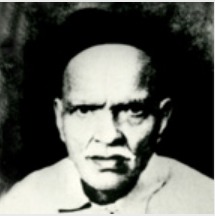
Dr. Keshav Laxman alias Bhauji Daftari
Keshao Laxman, alias Bhuji Daftari, was the man par excellence residing in Nagpur, in Maharastra. He excelled in different faculties of learning. He belonged to the school of “Buddhipramanyavad”, i.e. accept that which appeals to your conscience. Expanse of his research was extensive containing Dharmashastra, Law, Upanishads, Astronomy, and Homeopathy. In all these fields he has done pioneering work which has been admired by the erudite in respective fields. Whenever he had chosen to write something, it was thought provoking and original. He used to say that he did not lift his pen unless there was something new and original to write. Most of the time his writings went against the traditional opinions and hence he incurred wrath of the fundamentalists. For example, he proclaimed that the Vedas were narrated by human beings and did not come from the God’s mouth, as was then firmly believed. The book, “The Rationalistic and Realistic Interpretation of Upanishads”, is Bhauji’s interpretations of different Upanishads. Dr. Sarwapalli Radhakrishnan, a renowned philosopher, and later the Vice President of India and then the President of India, was so impressed by his book that he had personally chosen to come to Nagpur for its release. Another towering political personality Lokmanya Bal Gangadhar Tilak was so mesmerized by Bhauji’s knowledge of astronomy that he entrusted him with the responsibility of writing, “Karanakalpalata”, the book containing mathematics of almanac formation. Bhauji accomplished this task proficiently and was awarded one thousand rupees for this work by Lokmanya. He exerted himself so much in this work that he was compelled to say, “my brain is broken into pieces in completing the work.” He was one of the members of Calendar Reform Committee established by Council of Scientific and Industrial Research, Delhi, under the Chairmanship of Dr. Meghnath Saha. Its purpose was to reform almanac. Here he differed from the majority opinion. His dissenting note has been included in the final report published in the gadget.
Homeoathy was dearest to Bhauji. He believed that this was the true healing system which cures diseases without any side effects, was cheap, and hence within the reach of a common man. He accepted Dr. Hahnemann, the founder this system, as his guru. But he did not accept all his principles blindfolded, for they did not appeal to his conscience and he believed that no man is infallible. He continued the incomplete work of his master to give credence to this system. The very basic principle, similia similibus curanter or like cures like, on which the whole edifice of homeopathy was to stand, was challenged by the more established system of therapeutics which was based on the principle, contraria contraries curanter i.e. unlike cures like. There was no answer to this criticism and to the infinitesimal homeopathic dilutions which cured diseases – in the latter the drug could not be quantified. Bhauji enunciated laws of “bodily reactions” which gave firm scientific basis to the therapeutic system and established it as the exact science, like mathematics. This was his original contribution and the revolutionary work answering many queries. However, Bhauji was well aware of the limitations of homeopathy, especially in the selection of a drug. It was chosen arbitrarily without any guiding principle. To select the most appropriate remedy among the innumerable drugs was a daunting task. Bahuji, therefore, adopted Schussler’s Twelve Tissue remedy in which there are only twelve medicines among which it is easy to select the most appropriate remedy, and moreover there was a logic in this selection. Moreover, the basic principle of this medicinal system is the same as homeopathy”. But Bhauji modified some concepts of Schussler which were unacceptable to him. Dr. Daftari was instrumental in passing Homeopathic and Biochemic law in then M.P. State with the help of Dr. Barlinge, its Health Minister, in 1952. This gave homeopathic doctors legal sanction of practice. The medical fraternity is extremely grateful to him for this gesture.
Dr. Daftari was a true patriot. This is substantiated by the following examples. He was awarded D. Lit. by Nagpur University in 1941. He accepted the degree on two conditions: (1) that he would not shake hands with the Governor who was a British and (2) that he would only wear khadi clothes. Bhauji was closely associated with the Congress party and was its treasurer when Barrister Abhyankar was sent to jail during Natioalist Movement. Mahatma Gandhi was Bhauji’s contemporary. The former invited the later in Sevagram Ashram to have dialogue about untouchability. Bahuji was a reformist and did not sanction untouchability. On the contrarary, he along with his family was outcast by the fundamentalist Brahmins for his participation in a social function in which the downtrodden were invited. But this act did not deter him from his path. He has written a book, “Social Institutions in Ancient India”, which describes then prevailing social structure. Swatantra Bharatacha Pudhil Marga i.e. the path free India should select is a book which recommends Socialism for the economic development.
The Trust runs mainly on donations collected from generous public. In various clinics in and around Nagpur patients are treated free of cost. The response is encouraging. Besides this, the Trust plans to construct a homeopathic hospital in the space donated by one of its members. The progress of the Trust has been praiseworthy up till now. More information regarding Trust can be obtained from its website www.daftaritrust.in
The Trust appeals to the public to donate generously towards this noble cause. Donations may be sent to the Trust’s address given on the front page or Deposited in Trust account in Bank of India, Mahal Branch. (A/c. 870410100021936). Donation are exempted under 80C.